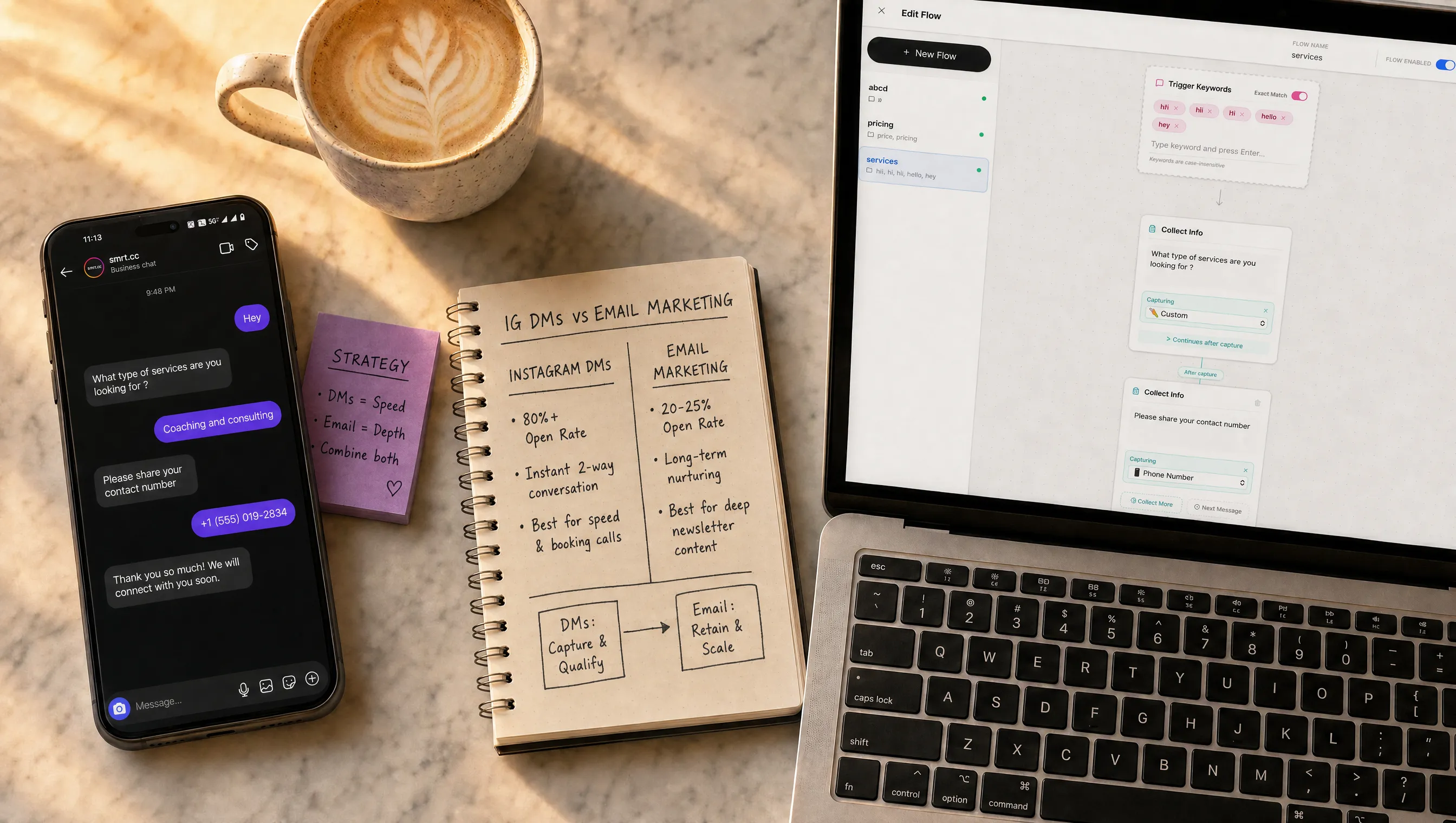
Instagram DM vs Email Marketing: The Engagement Numbers
Instagram DMs and email marketing are not competing for the same job. They perform at different stages of your funnel and excel at different things. But the raw engagement numbers explain why so many creators and businesses are shifting attention toward DMs.
I tested this myself across multiple client accounts, and the pattern held consistently. The benchmarks below come from industry reports and several automation platforms throughout 2025 and 2026.
| Metric | Instagram DMs | Email Marketing |
|---|---|---|
| Open Rate | 80% to 90% | 20% to 40% |
| Reply / Click Rate | 50% to 60% (reply) | 2% to 5% (CTR) |
| Conversion Rate | 7% to 20% (targeted) | 1.5% to 3% (average) |
| Average Response Time | Under 5 minutes | 6 to 24 hours |
| Spam/Promo Filtering | None (primary inbox) | High (promo tabs, spam) |
| Long Term ROI | Hard to isolate | $36 per $1 spent |
| Audience Ownership | Platform dependent | Fully owned |
The open rate gap is not a small margin. DMs land in the same inbox where your audience talks to their friends. There is no promotions tab. No spam folder. No subject line A/B test required. The message just shows up.
But before you ditch your email list, look at that last row. You own your email subscribers. Instagram could change its algorithm tomorrow, restrict your reach, or update its messaging policies. Your email list survives all of that.
Why Instagram DM Marketing Converts Faster on First Touch
Three things make DMs outperform email at the top of the funnel: context, speed, and intent.
Intent Is Already There
Someone comments 'INFO' on your Reel because they are interested right now. Not tomorrow. Not after they check their inbox during lunch. Right now. The DM arrives while their interest is still hot.
Speed Closes the Gap
An automated DM reaches them in seconds. An email follow up reaches them in hours, if they open it at all. That time gap is where leads go cold.
Conversations Build Trust
A DM feels personal. It is a one to one space where your audience already talks to people they know. An email from a brand feels like a broadcast. Both have their place, but the trust gap matters at first contact.
An online course creator we work with was manually replying to every comment on their launch posts. They would post a Reel, get 300 plus comments saying “COURSE,” and spend three hours copy pasting the same DM with the enrollment link. They set up a comment to DM flow that took 10 minutes. The next launch post got 400 comments, all 400 received the DM with the link within seconds, and they spent zero hours on manual replies. They said the tool “gave them their launch day back.”
That kind of immediate delivery is something email cannot replicate. Even with the best welcome sequence, the subscriber has to open the email first. And 60 to 80 percent of them will not.
Why Email Marketing Still Wins for Long Term Revenue
The $36 per $1 ROI that industry reports cite for email is not made up. It is the cumulative result of years of nurture sequences, segmented campaigns, and repeat purchases driven by a channel that businesses fully control. Nothing in the DM world matches that kind of compounding return. Not yet.
Here is where email genuinely outperforms DMs, and it is not close.
You Own the List
Your email subscribers do not disappear when a platform changes its rules. If Instagram locked your account tomorrow, every DM contact is gone. Your email list survives algorithm shifts, platform outages, and policy updates.
Segmentation That Scales
Email lets you send different messages to different people based on behavior, purchase history, and engagement level. DMs are mostly one to one. Email can be one to many with precision.
Drip Campaigns Convert Over Time
A 7 email welcome sequence can educate a lead, address objections, and close a sale across a week. DMs are built for quick exchanges, not structured multi day narratives.
Professional Expectations
For B2B sales, consulting proposals, and detailed product information, email is the expected format. A DM that says 'Here is our enterprise pricing PDF' feels out of place. Email does not.
How Instagram DM Marketing Boosts Your Algorithm Reach
Here is something email marketing cannot do: improve your organic reach. Instagram's 2026 algorithm treats DM shares as one of the strongest engagement signals. When someone sends your Reel to a friend via DM, the algorithm reads that as a quality endorsement. Industry analysis suggests DM shares carry three to five times more weight than likes when determining how far your content gets pushed.
This matters for DM automation because comment to DM flows naturally increase the volume of DM interactions on your content. More comments trigger more automated DMs, which signals to the algorithm that your content is generating meaningful engagement. It is a compounding loop: better content gets more comments, more comments trigger more DMs, more DM activity pushes your reach further.
Email lives entirely outside this loop. A brilliant newsletter does nothing for your Instagram discoverability. That is not a weakness of email. It is just a different game.
When Email Is the Better Channel for Your Use Case
DM automation and email marketing serve different purposes. If your business runs primarily on long form content, detailed proposals, or structured educational sequences, email is purpose built for those workflows. Here is when email is the stronger channel.
When to lean into email over DMs:
- Your product requires a 5 to 10 touchpoint nurture before purchase (coaching programs over $2,000, enterprise SaaS, consulting retainers)
- Your audience prefers long form communication and expects detailed case studies before buying
- You are selling to a B2B audience where email is the professional norm
- You have a large, warm email list that already converts well and just needs optimization
The best approach for most businesses is using both channels together. Use DM automation to start conversations and capture leads on Instagram, then move those leads into your email sequences for long form nurturing. The hybrid funnel section below walks through exactly how to set that up.
The DM to Email Funnel: How to Use Both Channels Together
The smartest marketers in 2026 are not choosing between Instagram DMs and email. They are using DMs to start conversations and email to nurture them. Here is how the funnel works in practice.
Capture Attention on Instagram
Post a Reel or Story with a clear CTA. "Comment GUIDE to get the free framework." The content does the work of attracting the right audience.
Deliver Value via DM
The automation sends the resource instantly. No landing page friction. No form to fill out. The lead gets what they asked for while their interest is at its peak.
Collect the Email Inside the DM
A multi step flow asks for their email before delivering the resource, or sends a follow up asking if they want Part 2 delivered to their inbox. The email capture happens inside the conversation.
Nurture and Close via Email
Once they are on your list, your email sequences handle the heavy lifting. Drip campaigns, testimonials, case studies, and offers that convert over days or weeks.
This funnel works because each channel plays to its strength. DMs handle the high attention, fast delivery moment. Email handles the slow, trust building arc. Neither channel is wasted.
Tools like AutomateYourDM make this practical by supporting multi step DM flows that collect email addresses and phone numbers mid conversation. The lead data exports to your email platform, and the funnel runs without you touching it.
Instagram DMs vs Email: When to Use Each Channel
Here is a practical breakdown based on what I have seen work across dozens of accounts. The answer is never “always DMs” or “always email.” It depends on the moment.
| Use Case | Best Channel | Why |
|---|---|---|
| Lead magnet delivery | Instagram DM | Instant delivery while interest is hot |
| Webinar registration | Instagram DM | One message, one tap, registered |
| 7 day nurture sequence | Structured storytelling over multiple days | |
| Product launch announcement | Both | DM for urgency, email for details |
| Customer support FAQ | Instagram DM | Conversational format, instant answers |
| Detailed case studies | Long form content suits email format | |
| Flash sale or limited offer | Instagram DM | Speed and open rate matter most here |
| Onboarding new customers | Step by step sequences with resources | |
| Re engaging cold leads | DMs require prior interaction within 24 hours | |
| Building follower count | Instagram DM | Follow gating before content delivery |
The 24 Hour Messaging Window: What Email Marketers Need to Know
One constraint that separates DMs from email: Meta's 24 hour messaging window. You can only send automated DMs to users who have engaged with your account (commented, replied to a story, sent a DM) within the last 24 hours. After that window closes, you cannot message them again until they re engage.
Email has no such limitation. Once someone is on your list, you can email them weeks, months, or years later. That persistence is email's greatest structural advantage.
But the 24 hour window is actually a good thing for DM quality. It ensures you are only messaging people who recently showed interest, which is why DM engagement rates are so high. You are never cold messaging. Every DM is a response to something the user did first. That is a feature, not a limitation. (If you want to learn more about this, we covered it in detail in our guide on whether Instagram automation is safe.)
How to Add Instagram DMs to Your Marketing Stack
If you are already running email marketing and want to add DMs to the mix, here is where to start. Do not try to migrate everything at once. Start small and measure.
Tools like AutomateYourDM handle the automation side. You connect your Instagram account through Meta's official API, set up your triggers and DM flows, and the system handles delivery, rate limiting, and lead capture. The whole setup takes under five minutes for a basic comment to DM flow. (We walked through the exact steps in our keyword trigger guide.)
The honest trade off is this: if you only have time for one channel, pick the one your audience already uses. If they are scrolling Instagram and engaging with your Reels, start there. If they are checking their inbox every morning and clicking your newsletters, double down on email. The data says DMs win on speed and attention. Email wins on durability and depth. The best strategy is not choosing. It is connecting both.
Frequently Asked Questions
Yes. Industry benchmarks from multiple platforms consistently show that automated Instagram DMs see 80 to 90 percent open rates, compared to 20 to 40 percent for email. The gap exists because DMs land in a personal inbox with no spam filter or promotions tab competing for attention.
No. DMs are excellent for immediate engagement and lead capture, but you do not own the platform. If Instagram changes its algorithm or restricts your account, you lose access to that audience. Email gives you a durable, owned communication channel that no algorithm can take away. The best strategy uses both.
Email marketing generates an average return of $36 for every $1 spent, according to industry research. Instagram DM ROI is harder to measure directly because it is typically part of a broader funnel. DMs tend to convert faster on first touch, while email converts better over long nurture sequences.
Yes, as long as you use a tool that connects through Meta's official Instagram Messaging API and only messages users who have engaged with your account first. The 24 hour messaging window ensures all automated DMs are responses to user initiated interactions, not cold outreach.
Use a multi step DM flow that collects email addresses during the conversation. When someone triggers a keyword, the automation can ask for their email before delivering the resource. The email gets stored in your dashboard and can be exported to your email platform.
Email is generally better for high ticket sales because it supports longer nurture sequences, detailed case studies, and segmented drip campaigns. DMs work better for qualifying leads and booking discovery calls. The combination of both is where high ticket businesses see the best results.